

This report was commissioned by GenZcash. By providing this disclosure, we aim to ensure that the research reported in this document is conducted with objectivity and transparency. All content was produced independently by the author(s) and does not necessarily reflect the opinions of Blockworks. or the organization that requested the report. The commissioning organization may have input on the content of the report, but Blockworks maintains editorial control over the final report to retain data accuracy and objectivity. Author(s) submit financial conflict of interest (FCOI) disclosures on a monthly basis that are reviewed by appropriate internal parties and may hold cryptocurrencies named in this report. This report is meant for informational purposes only. It is not meant to serve as investment advice. You should conduct your own research and consult an independent financial, tax, or legal advisor before making any investment decisions. Past performance of any asset is not indicative of future results. Please see our Terms of Service for more information.
Zcash Token Holder Report Q3 2026

Executive Summary
Zcash shipped the first layer of its scaling roadmap in Q3 2026. Zakura, a new full node released in mid-July, cut a full network sync from ~21 hours on Zebra to ~4 hours, and a node bootstrapped from a pruned snapshot is running in under two minutes. In late July, Ironwood (NU6.3) activated with a replacement shielded pool whose supply soundness is backed by a machine-checked proof. Holders moved into it quickly. The shielded share of supply rose from ~26% to ~29%, and total shielded ZEC grew ~12% to ~4.9M.
Zakura is a joint project of Valar Group, led by Osmosis cofounder Dev Ojha, and Project Tachyon, led by Zcash cofounder Sean Bowe. Its design target is ~50K private transactions per second, reached in stages: the node itself, Tachyon's recursive proofs, and Valar's private information retrieval for wallets. The Zakura Common cryptography release in late August made mobile proof generation more than 14 times faster, bringing a standard shielded transaction to ~200 milliseconds on an iPhone.
Coinholders then used the new pool to govern. Nearly 2.4M ZEC, about two-thirds of the eligible supply, voted in an encrypted poll on NU7. They backed 25-second blocks with 99.9% support, kept the halving schedule, and set the terms of the Network Sustainability Mechanism. Mainnet activation is scheduled for early November. In a separate vote, they approved ~$8.4M in grants from the protocol's coinholder-controlled fund, including ~$1.8M to Valar Group and ~$1M to Project Tachyon for their Ironwood work.
Activity rose with the migration. Transactions climbed 21% to ~710K, and more than half of all non-coinbase transactions touched a shielded pool, up from ~27% in Q2. Network difficulty averaged 55% higher. Network REV, the dollar value of fees users paid, rose ~85% to ~$204K.
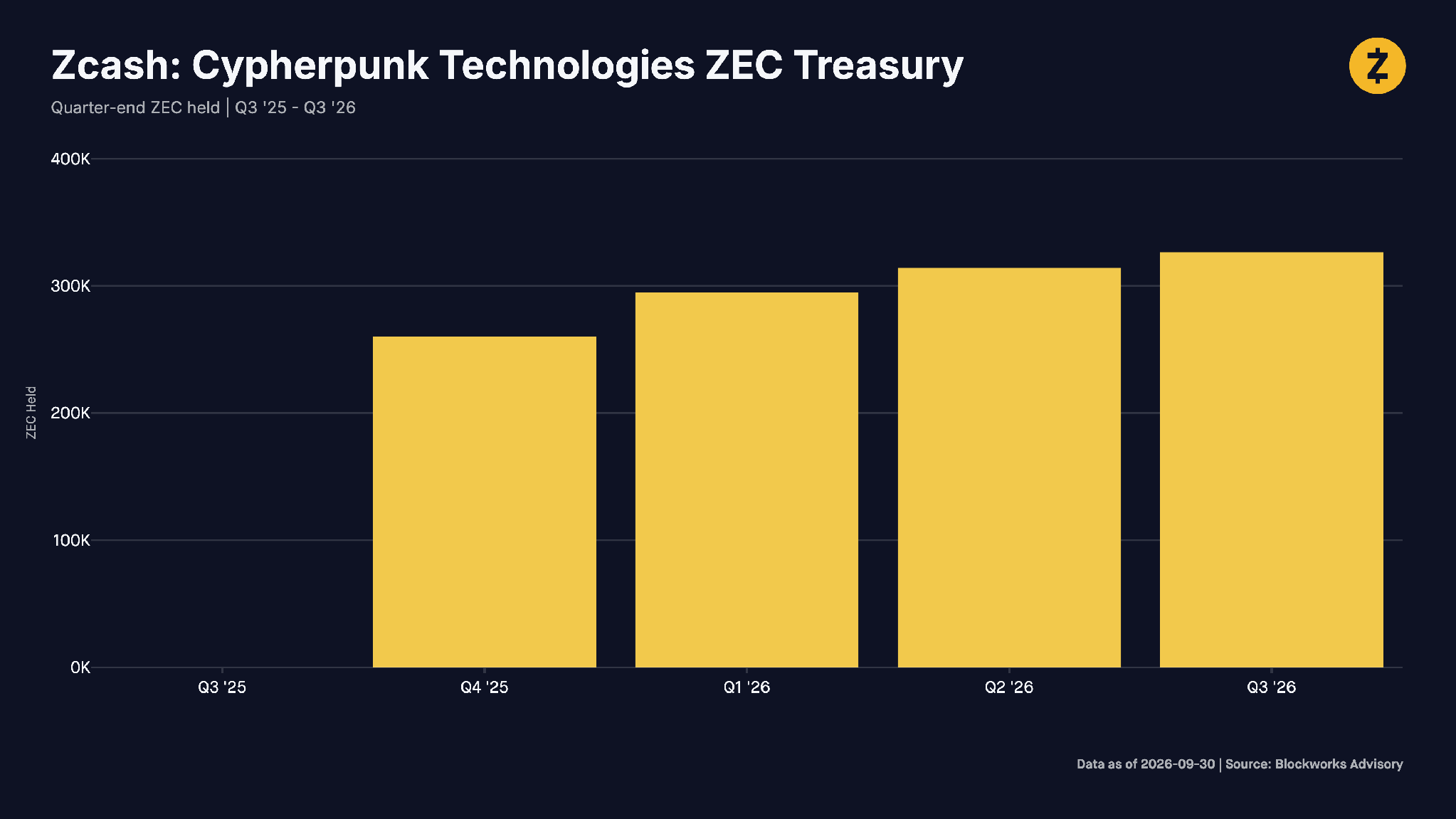
Institutional access widened on two fronts. Grayscale's ZCSH, the first U.S. spot ZEC exchange-traded product, began trading in late August with ~387K ZEC and drew ~$263M of net inflows by quarter end. Cypherpunk Technologies, the Nasdaq-listed public company with a ZEC treasury vehicle, lifted its holdings to ~326K ZEC and began mining.
Zakura and the Path to Scale
What shipped
Zakura is a consensus-compatible Zcash full node built from the Zebra codebase. Version 1.0.0 went live on July 15, ahead of the July 18 end of life for zcashd, the original node client. It shipped with Ironwood support, a compatibility mode that reproduces the zcashd interface for existing integrations, and snapshot-based bootstrapping. Zakura nodes mined mainnet blocks from launch day.
The first release cut sync time sharply. Block sync that took 20 hours 46 minutes on Zebra took 4 hours 20 minutes on Zakura. Bootstrapping from the roughly 11 GB pruned snapshot took 1 minute 50 seconds, which the team measures as 680 times faster than syncing over the standard peer-to-peer network. Version 1.2.0 cut block processing time by 87%. Version 1.5.0, in late September, gave miners faster block commits and steadier templates.
The cryptography layer
Zakura Common, released on August 29, is an open-source toolkit of cryptographic optimizations that Zcash wallets and nodes can adopt. On Zakura's benchmark hardware it makes mobile proof generation more than 14 times faster, desktop proving more than 5 times faster, Sinsemilla hashing more than 21 times faster, and zk-SNARK verification between 4 and 8 times faster. For users, a standard two-input, two-output shielded transaction now takes about 200 milliseconds on an iPhone, down from more than three seconds. Zakura 1.3.0 moved onto the new stack on August 31. The Vizor wallet was among the first to adopt it.
The route to the throughput target
The team's stated target is on the order of 50,000 private transactions per second. At Zakura's launch, Ojha put the network's shielded capacity at about 2.92 TPS on 75-second blocks, and he places the target two to three years out. With Zcash's existing cryptography, that load would require a node to process more than 500 MB of data per second. Each shielded transaction carries its own proof. Zakura handles the node's performance and networking. Project Tachyon's recursive proofs let a node verify one aggregated proof in place of thousands, cutting the requirement to about 100 MB per second, while Valar Group's private information retrieval work targets the wallet side, where today's stack caps throughput near 1 TPS.
Tachyon's integration into Zakura Common began on September 28. Zakura also stress-tested a large distributed network of its nodes and reported Zcash ready for 25-second blocks, the change NU7 now schedules for November. Bowe, who co-invented the Halo 2 proving system, has been responsible for Zcash's zk-SNARK implementations at launch and in every network upgrade since. Both teams started out on private donations from ZEC holders. In September, coinholders voted to pay them from the protocol's coinholder-controlled fund for their Ironwood work.
Network Performance
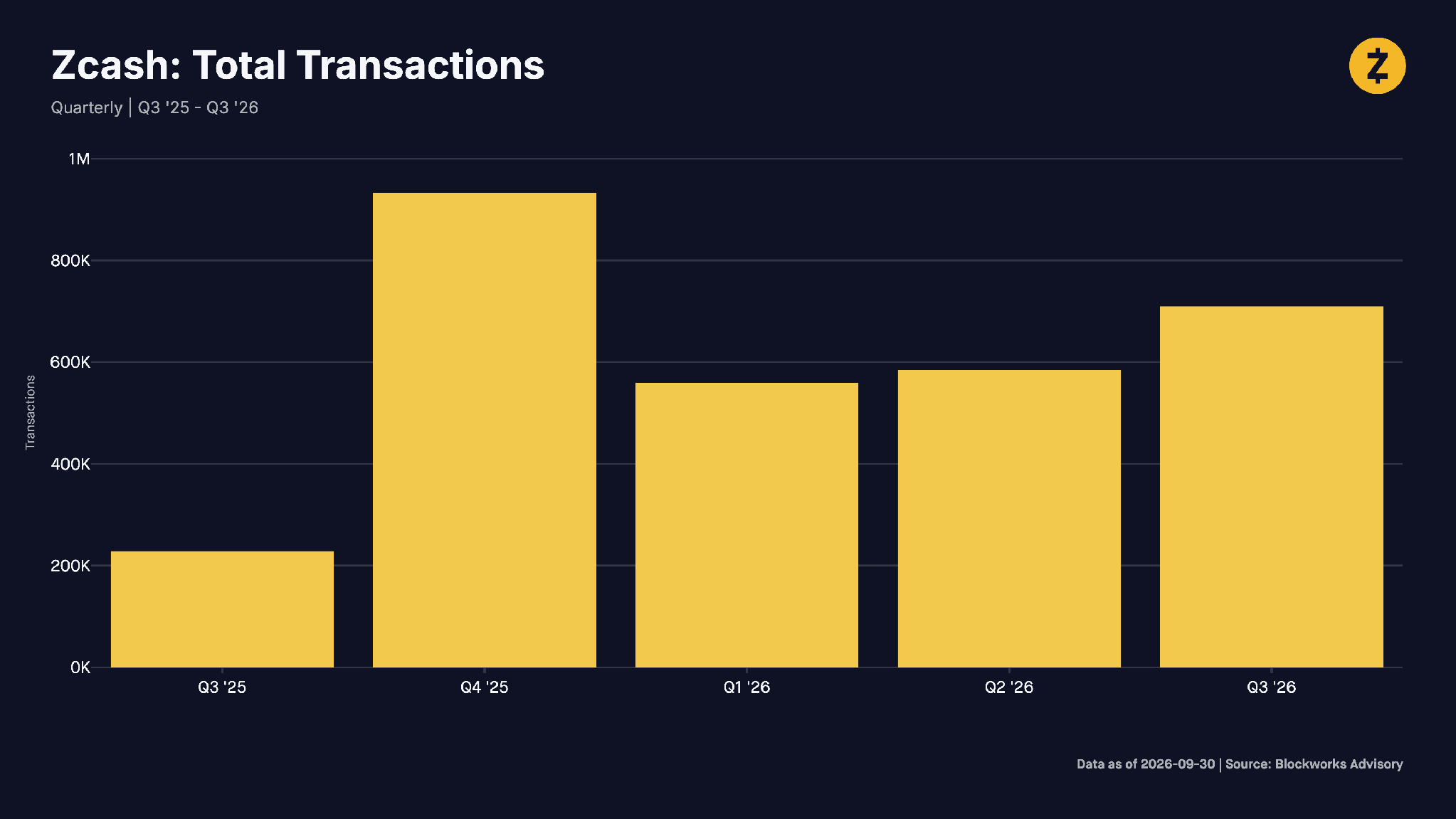
Zcash processed 710,047 transactions in Q3, up 21% from 585,178 in Q2 and three times the 228,313 of Q3 2025. Of the last five quarters, only Q4 2025, at 933,284, recorded more. Daily activity averaged about 7,700 transactions against roughly 6,400 in the prior quarter, and it built through the quarter: daily transactions averaged about 4,400 in July and roughly tripled to 13,300 in September. Part of the rise is mechanical. Wallet-led migration out of Orchard generated its own traffic, and Zodl's privacy-preserving migration splits balances into standardized denominations (0.1, 0.5 and 1 ZEC) sent on randomized timing, which produces several transactions per migrating balance by design.
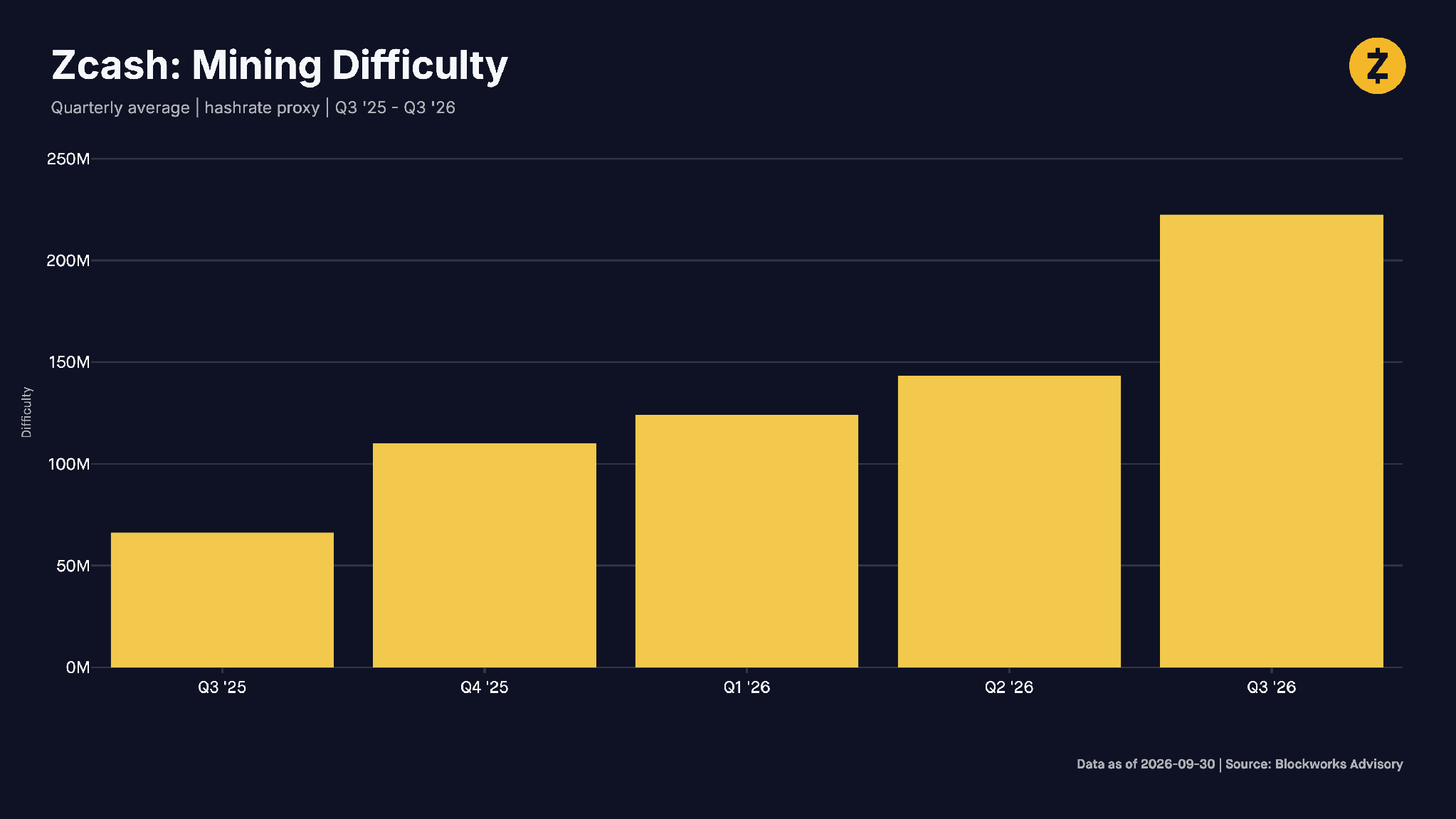
Hashrate rose faster than activity did. Network difficulty, the closest available proxy for it, averaged 222.6 million in Q3, 55% above the Q2 average of 143.4 million. It has risen every quarter since Q3 2025, more than tripling from 66.3 million. Block production held on schedule. Blocks arrived every 75.3 seconds on average, 105,487 in all, against a 75-second target.
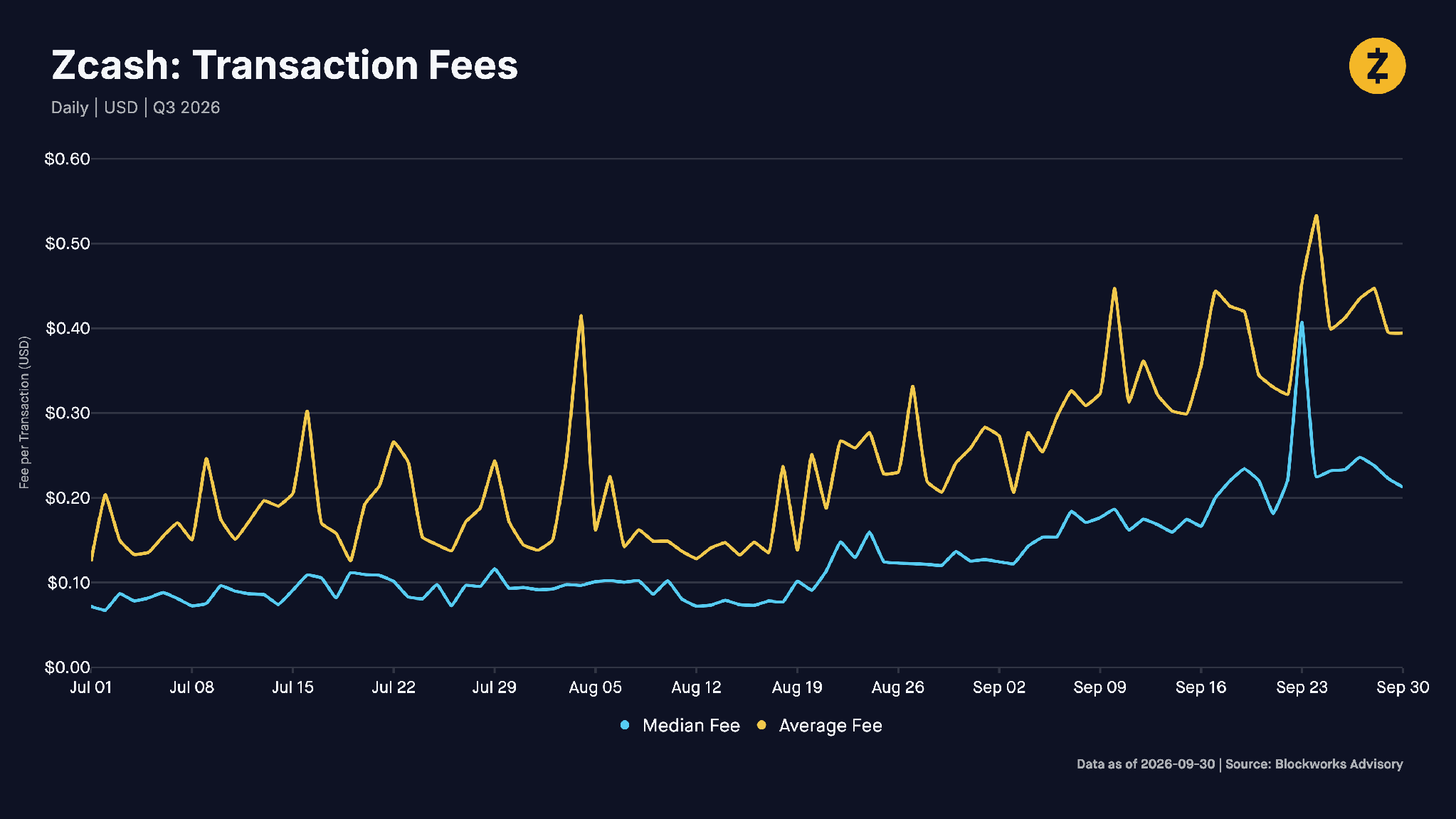
The median transaction fee averaged about $0.13 in Q3, up from about $0.07 in Q2, and the average fee rose from $0.18 to $0.24. Zebra also added support for a lower conventional fee of 1,000 zatoshis per logical action, down from 5,000, giving wallets the option to charge less.
Zcashd reached end of life on July 18, and its operators moved to Zebra and Zakura. Zebra 6.0.0 shipped full Ironwood support ahead of activation, and Zakura 1.0.1 fixed inherited vulnerabilities in releases coordinated with the Zcash Foundation, with no user funds at risk. Ironwood itself activated on July 28 at block 3,428,143, one week later than first planned after exchanges and wallet providers asked for more preparation time. The upgrade introduced the v6 transaction format for the new pool.
Supply, Flows, and Usage
Shielded supply recovered
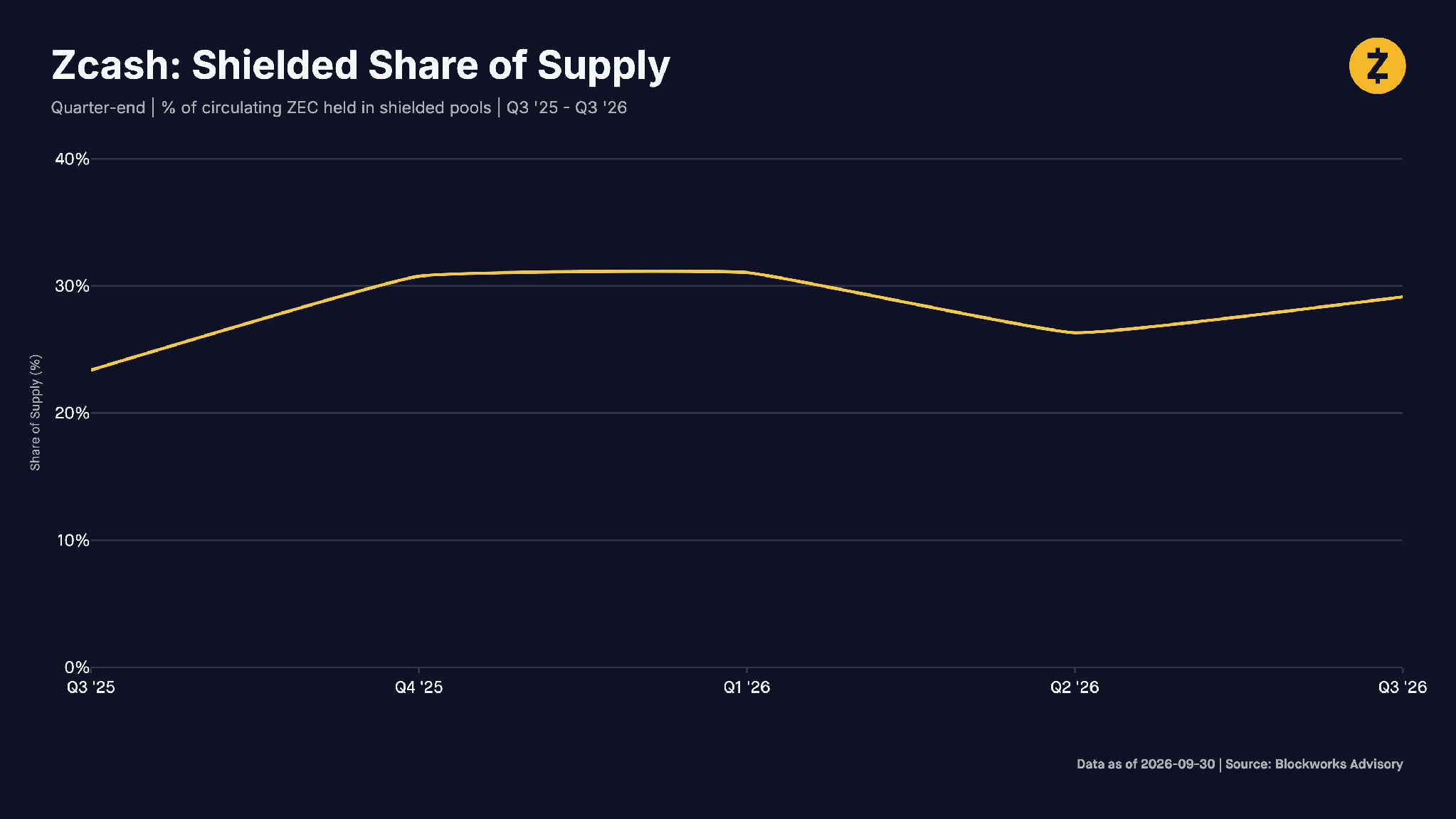
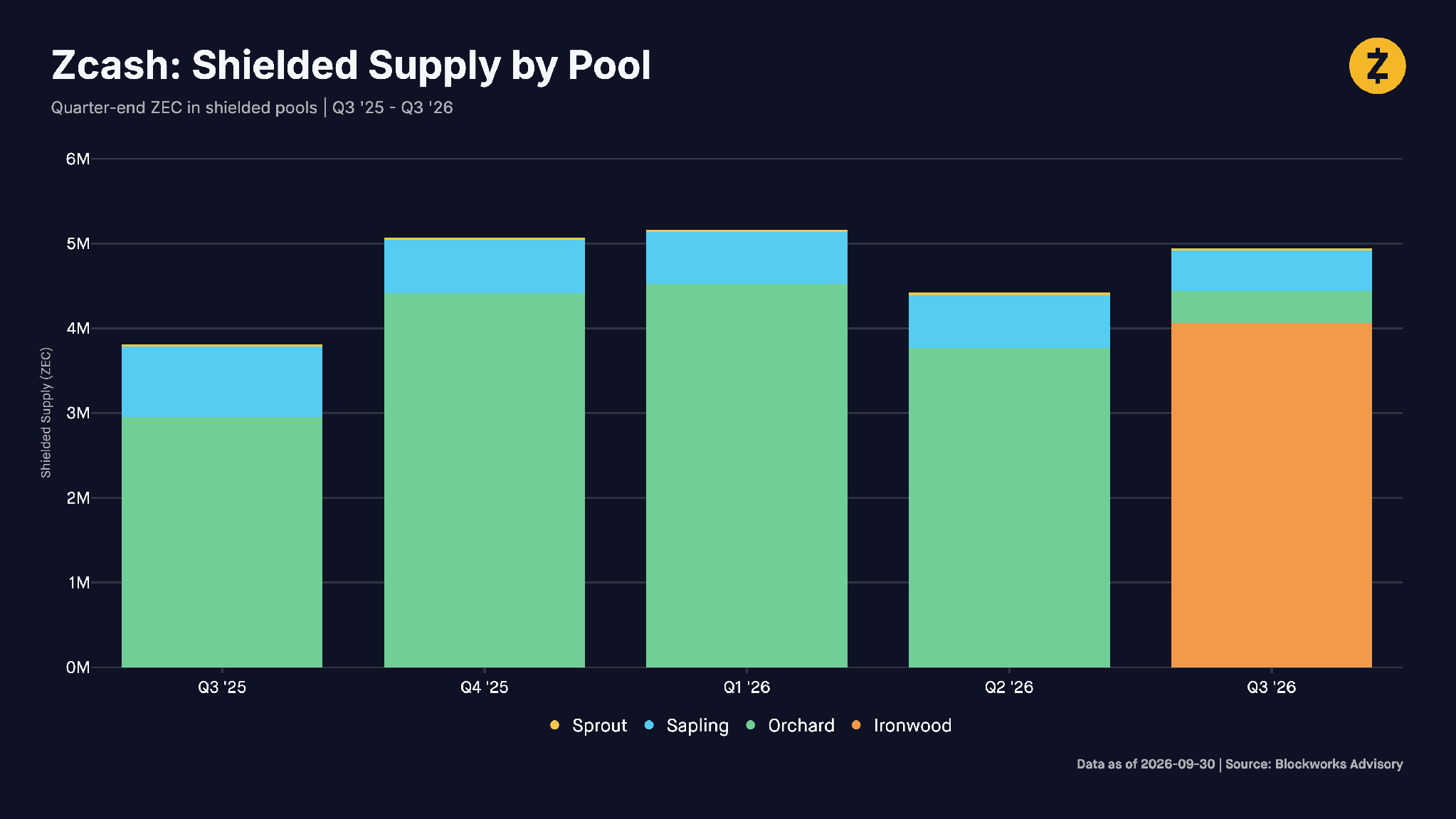
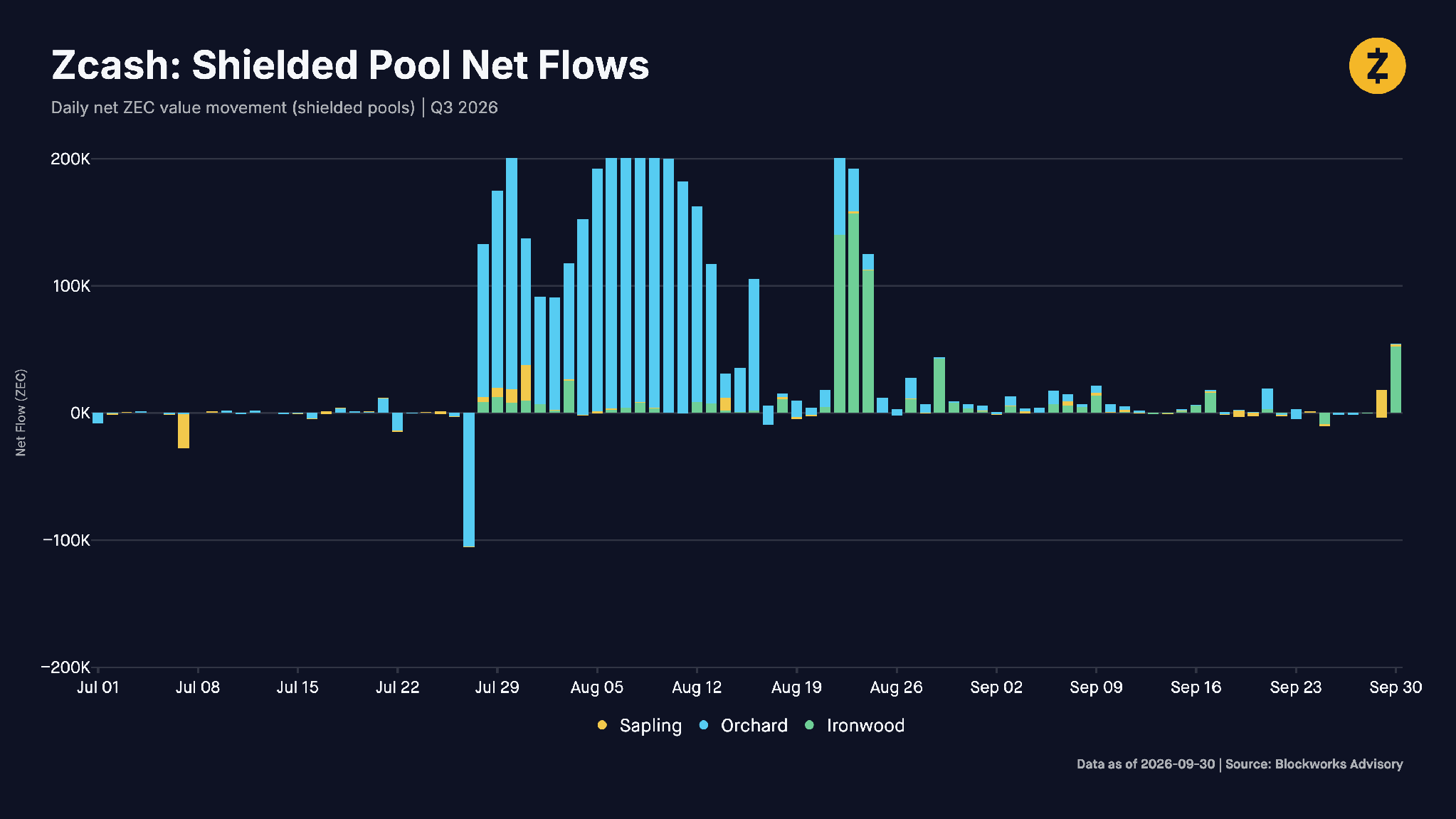
Total ZEC held in shielded pools rose 11.8% in Q3, from 4.42 million to 4.94 million, and the shielded share of supply climbed from 26.3% to 29.1%. The quarter recovered much of the contraction that followed the Orchard disclosure in Q2. The transparent pool shed a net 378,000 ZEC over the quarter while shielded pools gained 523,000.
The composition of the shielded supply changed completely. Ironwood started from zero at activation on July 28 and closed the quarter holding 4.06 million ZEC. More than 1 million ZEC migrated within seven days of activation, and more than 3 million had arrived by August 16. Orchard, which held about 3.66 million ZEC when Ironwood sealed it to new deposits, fell to 379,000. Sapling declined 23% to 479,000 ZEC, and Sprout held about 22,000.
Usage shifted into the new pool
Shielded activity grew faster than the network as a whole. Transactions touching a shielded pool made up 52.7% of all non-coinbase transactions in Q3, against 27.4% in Q2. Ironwood alone recorded 226,452 transactions after activation, plus 24,976 mixed Orchard-to-Ironwood transactions that carried migrating value through the turnstile. By count, withdrawals from Ironwood to transparent addresses outnumbered deposits into it, 159,020 to 67,429, even as net value moved into shielded pools.
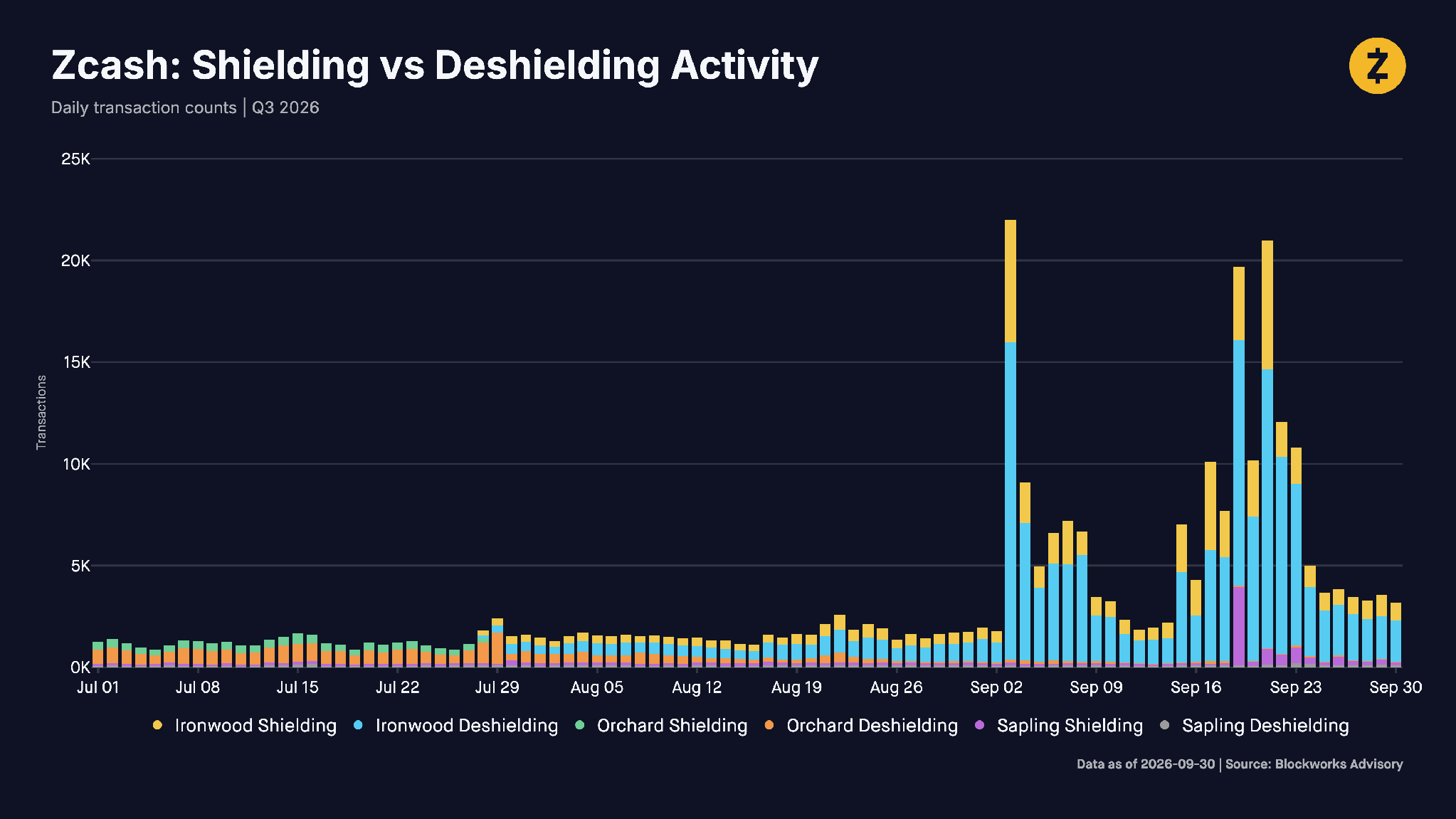
Zodl made migration a guided wallet feature on every supported platform by August 10, and its Migrate with Privacy mode implements ZIP-318 so that cross-pool transfers do not expose exact balances. Hardware support followed. Vizor enabled shielded ZEC on Ledger devices in mid-September, and Ledger Wallet added shielded Zcash support on September 23.
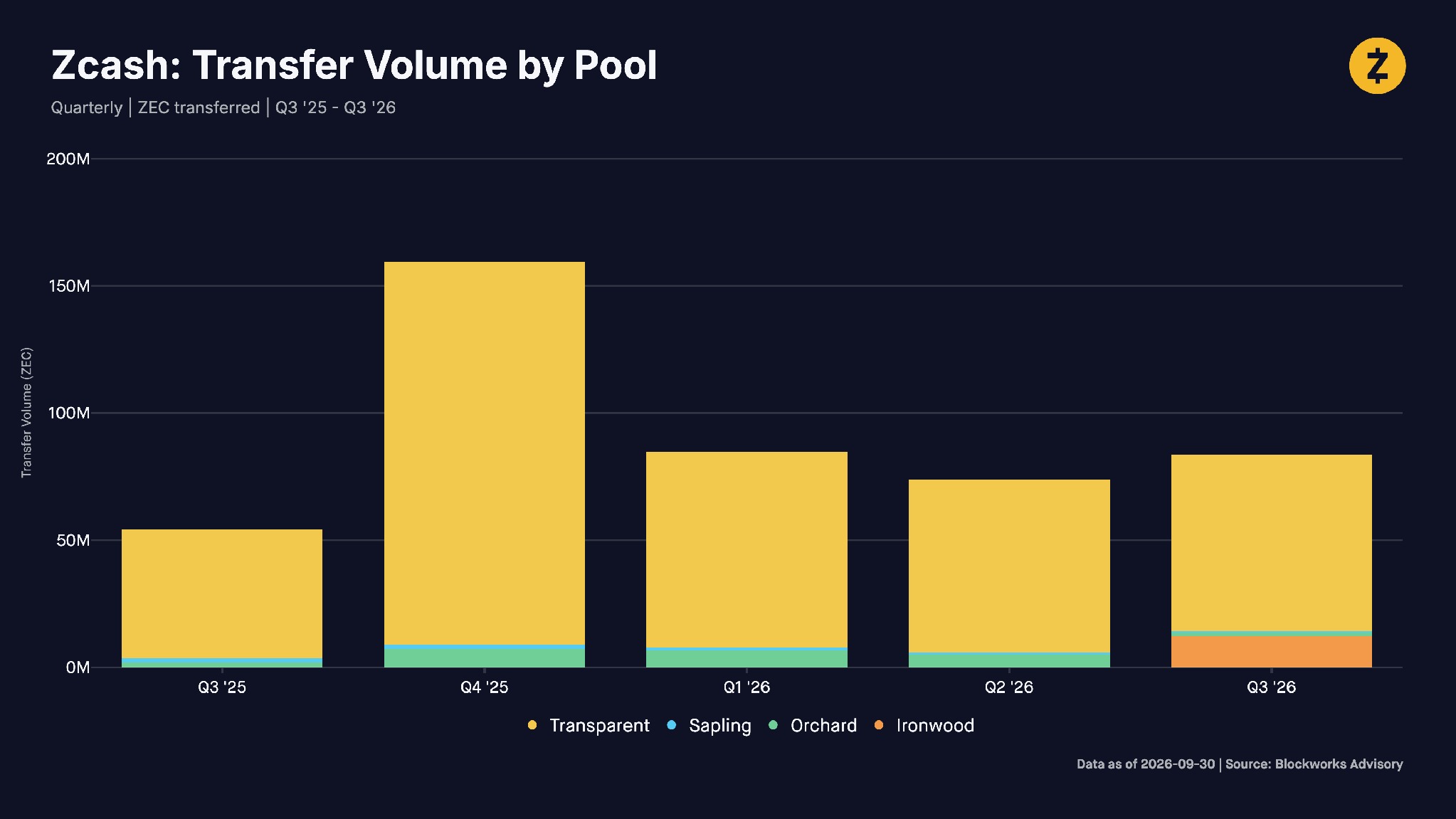
Total value transferred rose 17% to 87.0 million ZEC. Ironwood carried 12.4 million ZEC of that in its first two months, and mixed Orchard-to-Ironwood transfers another 3.3 million, with transparent transfers making up the remaining bulk.
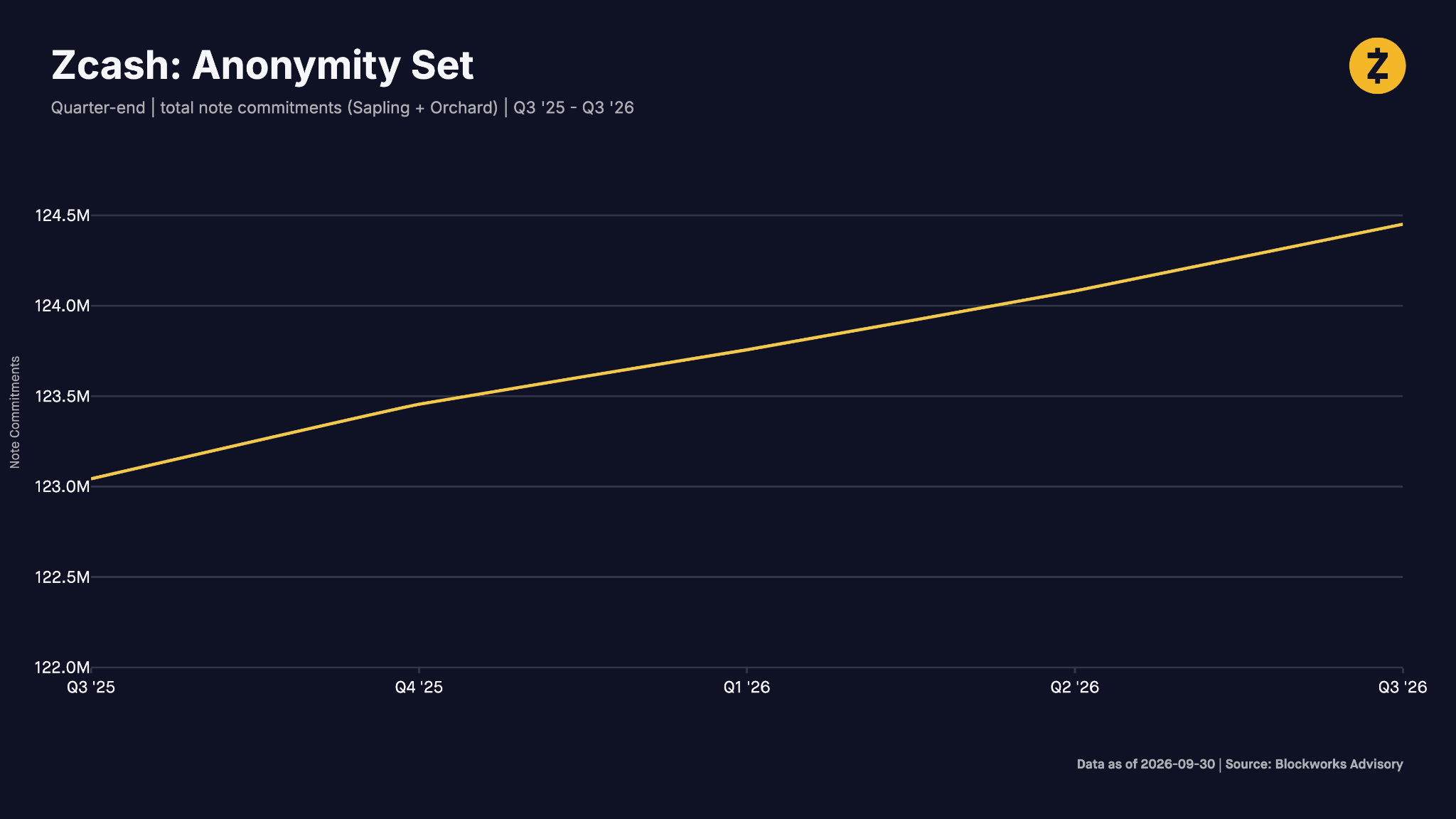
The anonymity set for the Sapling and Orchard pools stood at 124.5 million note commitments at quarter end, against 124.1 million at the end of Q2. That measure predates Ironwood and does not yet count Ironwood notes, so it understates the privacy set available to users who have migrated.
Market Structure & Economics
Fees and network REV
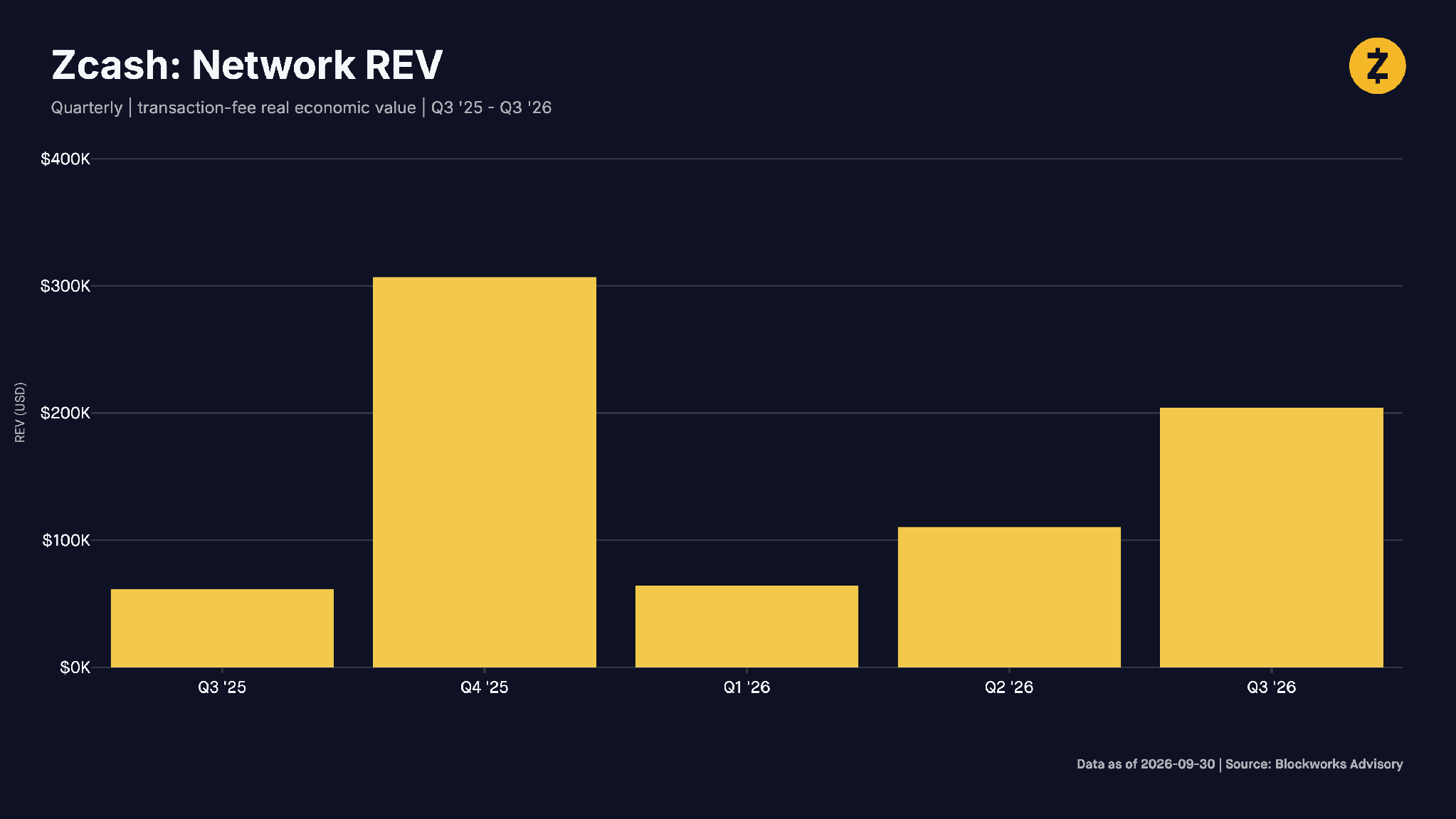
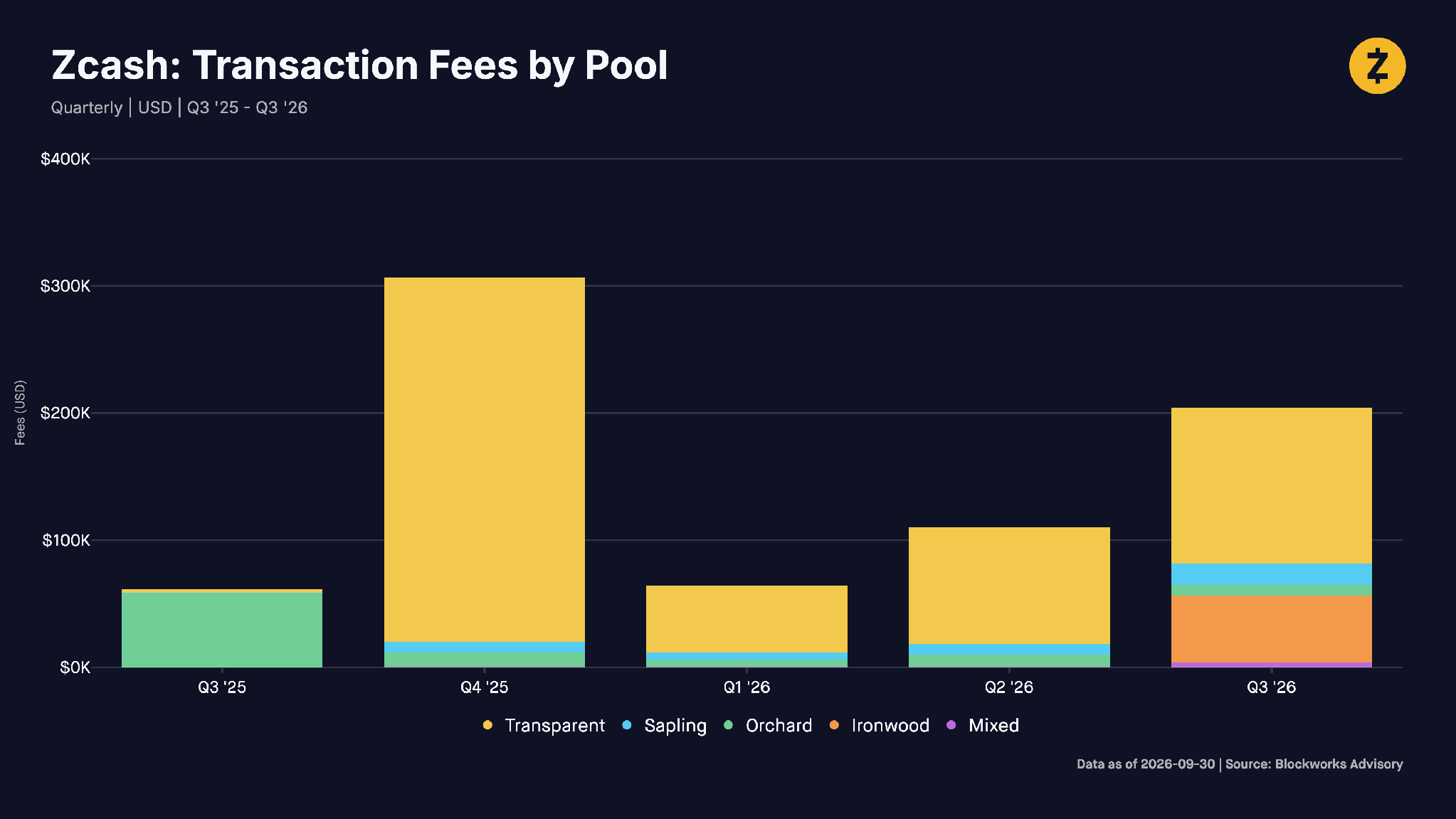
Network REV, the dollar value of the transaction fees users paid, was about $204,000 in Q3, up 85% from roughly $110,000 in Q2. The fee mix moved with the migration. Transparent transactions generated 60.1% of fee value in Q3, down from 83.6%, while Ironwood generated 25.9% in its first two months and mixed Orchard-to-Ironwood transactions another 1.7%.
NU7 changes how those fees work from November. The Network Sustainability Mechanism removes 60% of transaction fees from circulation and later recycles that ZEC to miners through future block rewards, without changing the 21 million maximum supply. Coinholders voted 96.6% to hold reissuance until February 2031, so several years of fees accumulate before any of it returns to the security budget.
Institutional access
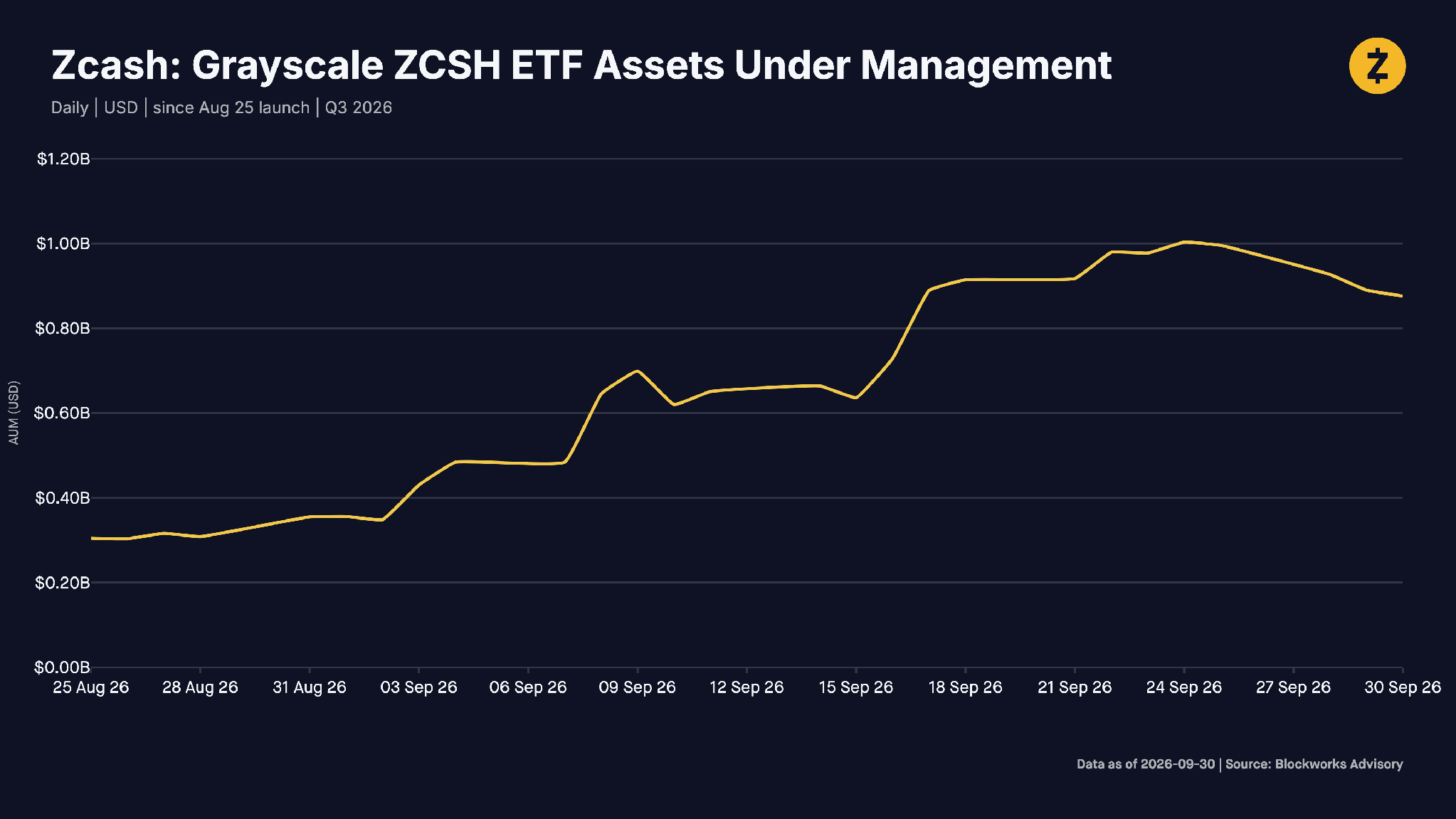
Grayscale converted its Zcash Trust into ZCSH, the first U.S. exchange-traded product offering spot ZEC exposure, which began trading on August 25. The fund launched with roughly 387,000 ZEC, is custodied by Coinbase, and uses Jane Street and Virtu as authorized participants. It recorded about $263 million of net inflows through quarter end, and assets under management reached about $996 million by September 25. Early fee revenue from the fund is earmarked for Zcash ecosystem development. On September 25 Grayscale filed for a second product, an options-based ZCSH High Income ETF that would not hold ZEC directly.
Cypherpunk Technologies, the Nasdaq-listed public company with a ZEC treasury vehicle, increased its holdings from 314,186 ZEC to 326,417 ZEC over the quarter, a position valued at about $463 million at quarter end. The additions included 3,023 ZEC from its own mining operation, which launched in mid-August. Cypherpunk also appointed Valar Group founder Dev Ojha as an advisor.
Liquidity and reach
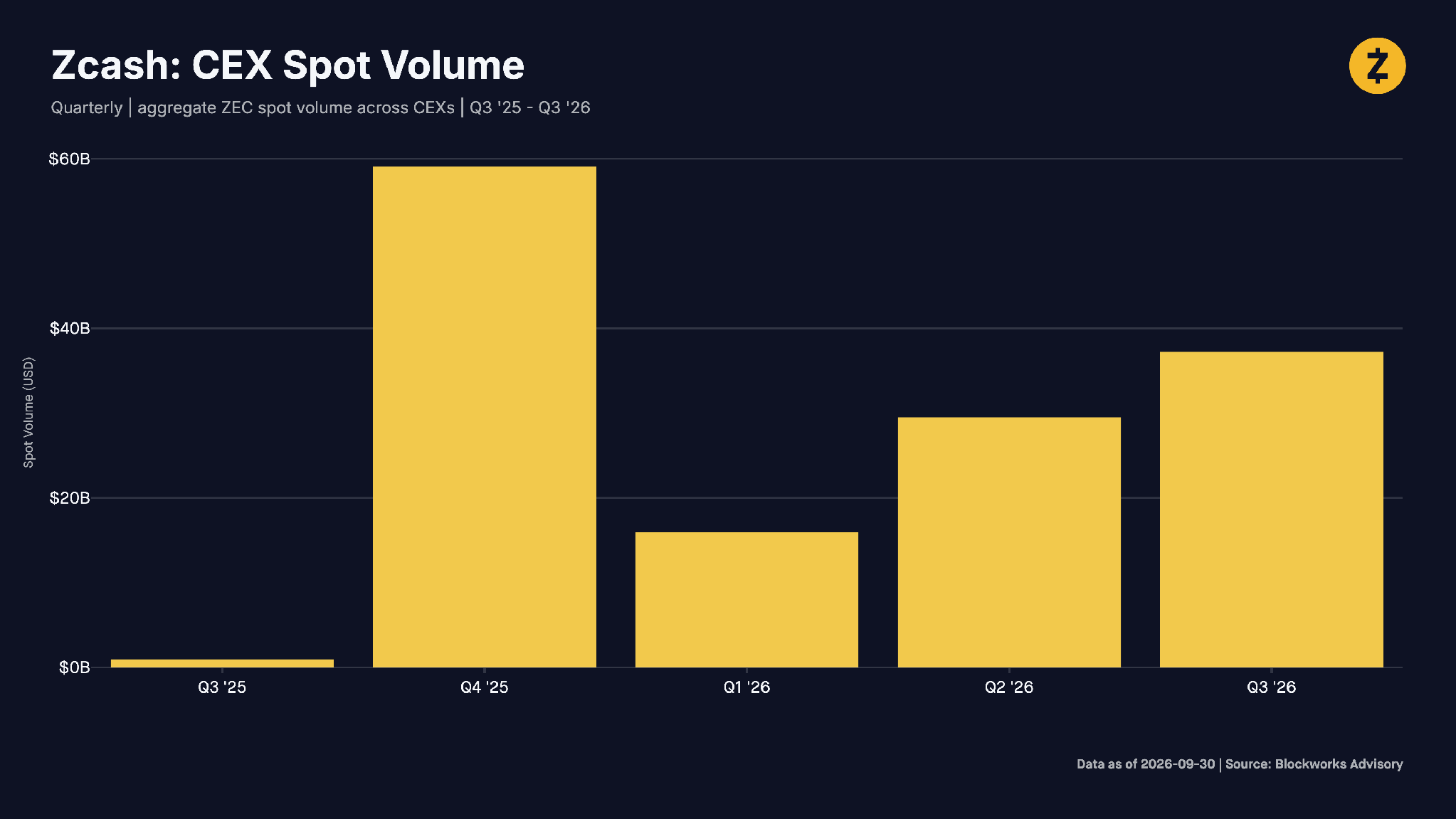
Centralized-exchange spot volume in ZEC rose 26% to $37.2 billion across about 13 venues.
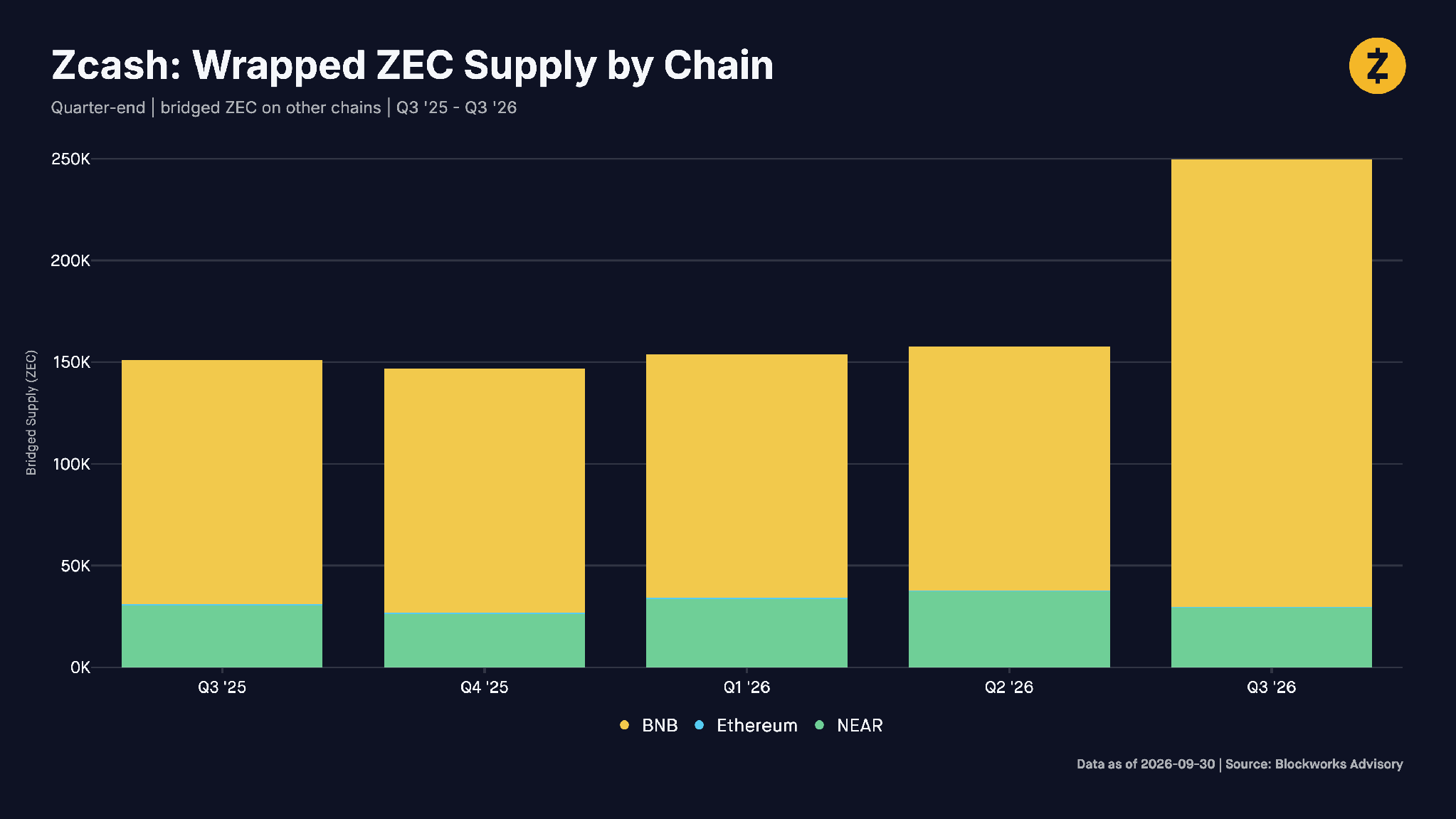
On BNB Chain, where ZEC circulates as the Binance-Peg token, supply rose from 120,000 to 220,000 ZEC in a single step on September 7, its first change since March 2024. On NEAR, home of the NEAR Intents swap service that Zodl and Vizor use for in-wallet ZEC swaps, bridged ZEC swung between about 25,000 and 39,500 ZEC and hit its low on September 16, the week daily ZEC volume through the service rose sixfold; it closed the quarter at 29,300, down from 37,400 at the end of Q2. A wrapped ZEC asset, cbZEC, launched on Base on September 1, bringing ZEC to EVM DeFi as collateral.
Mining & Block Rewards
Block subsidies paid 141,882 ZEC in Q3. Miners received 128,939 ZEC of it and the Zcash Community Grants funding stream 12,893 ZEC, while the dev-fund lockbox, which accumulates its share of issuance outside those two streams, grew from about 46,900 ZEC to 66,700 ZEC. Issuance is fixed per block. These totals therefore track block production, which held at 75.3 seconds per block.
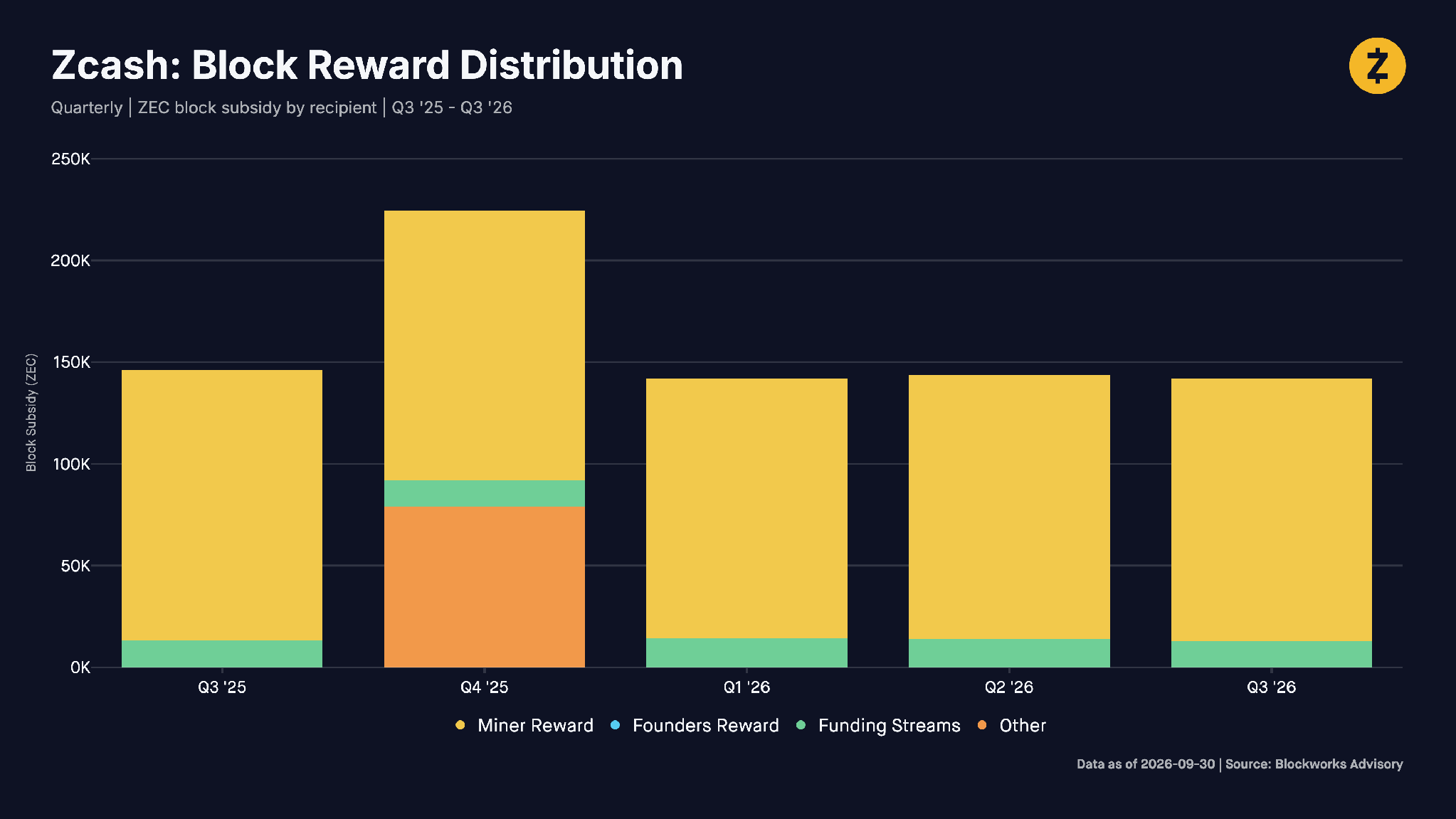
Mining capacity kept growing. Average difficulty ran 55% above the Q2 level, and daily distinct reward recipients averaged 16.8 addresses against 16.2 in Q2. That count measures payout addresses, not independent operators. It held steady while difficulty climbed, so the added hashrate did not arrive through a narrower set of payout addresses.
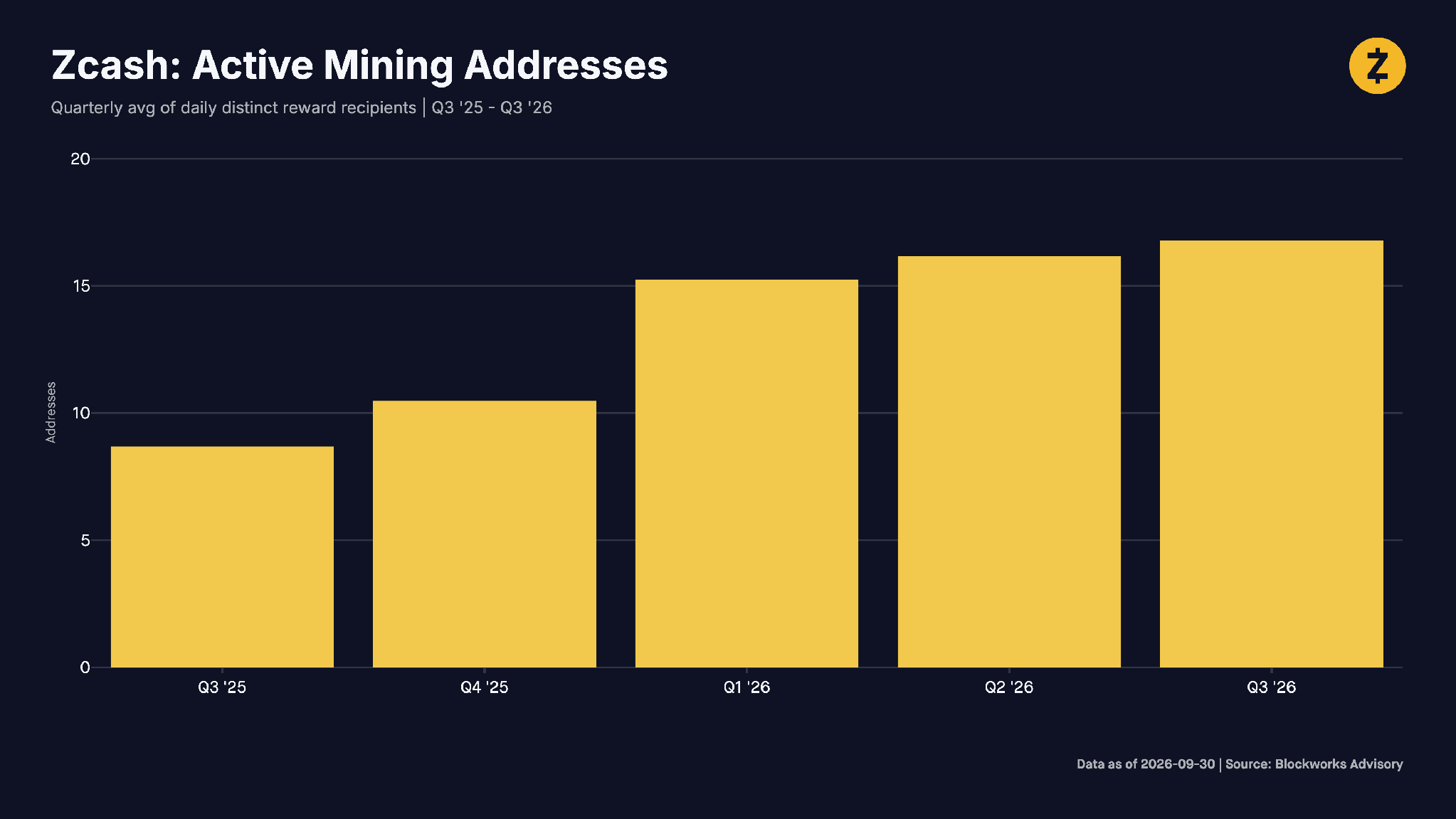
A public-company miner joined the network. Cypherpunk Technologies began mining ZEC in mid-August through its Cypherpunk Mining subsidiary, producing 3,023 ZEC between August 18 and August 31. All of it went to the treasury. It then appointed Amanda Fabiano, who previously held senior mining and investment roles at Fidelity and Galaxy, to its board to support the expansion.
Mining software improved too, on both node clients. Zakura 1.4.0 added fast proving for shielded-coinbase block templates, and Zakura 1.5.0 in late September brought faster block commits and steadier templates. Zebra 6.4.1 added an end-of-support halt around November 2 ahead of NU7, and an emergency 6.4.2 security release on September 28 recalled 6.4.0 and 6.4.1, so Zebra operators need to upgrade before NU7.
NU7 changes block timing and leaves issuance on the same path. Blocks will arrive every 25 seconds in place of 75, and under ZIP-218 the per-block subsidy is divided by an additional factor of three so that total issuance per unit of time stays the same. Halvings stay. Coinholders voted 98.9% to keep the fixed-interval cuts to new issuance over a smoother curve, and NSM-collected fees begin flowing back to miners through block rewards in February 2031, adding to the security budget as the subsidy keeps halving.
Organizational & Tech. Progress
Ironwood and its proof
Ironwood closed the Orchard chapter that opened in Q2. The Orchard flaw allowed counterfeiting inside that pool, while the turnstile kept any such value from reaching total supply, and developers found no evidence it had ever been exploited. Ironwood replaced Orchard with a new pool and made Orchard exit-only, routing every withdrawal through the turnstile. The Zakura team frames the migration around three goals: a credibly sound shielded pool, evidence that no counterfeiting occurred in Orchard, and a re-established circulating supply.
The new pool shipped with a machine-checked proof, written in Lean, of more than 2,700 theorems developed over more than a month by three teams led by Tal Derei (Project Tachyon), Daira-Emma Hopwood (ZODL) and Gregor Mitscha-Baude (zkSecurity). It formally verifies that Ironwood cannot create undetectable counterfeit ZEC under its stated design assumptions. The proof covers Ironwood only, and the same claim cannot be made for Orchard's history. The Zakura team describes Ironwood as the first shielded pool formally verified against supply-soundness bugs. Independent audits commissioned by the Valar and Tachyon teams found no major issues.
Ironwood also delivered quantum recoverability under ZIP 2005. Future quantum computers could not retroactively steal or counterfeit funds in the pool, and holders would keep a path to recover their ZEC. The design does not make today's transactions quantum-secure; a separate recovery protocol would still need to be designed and activated.
Two coinholder votes
The NU7 vote combined broad turnout with ballot privacy. Only spendable ZEC held in Ironwood at the August 24 snapshot could vote. Ballots were encrypted and each was split into 16 unlinkable pieces, so validators could tally totals without learning who voted or how much ZEC they held. Valar Group built the protocol using homomorphic encryption and private information retrieval. Voting ran from August 25 to September 14.
Nearly 2.4 million ZEC took part out of roughly 3.6 million eligible, well above the 1 million ZEC turnout threshold and far above the 7.25% of circulating ZEC that joined February's sentiment poll. Holders backed 25-second blocks (99.9%), kept halvings (98.9%), chose to ship NU7 as soon as possible with a September 30 readiness deadline (99.3%), and deferred NSM reissuance to February 2031 (96.6%). They also voted to retire the Sprout pool's legacy transactions.
A second vote, which closed on September 29, put the protocol's coinholder-controlled development fund to work. That fund receives 12% of block rewards, and each grant needs at least 420,000 ZEC voted and a simple majority in favor. Coinholders approved 17 of 37 retroactive grant proposals worth about $8.39 million, 93.1% of the $9.01 million requested, with turnout reaching 2.18 million ZEC on the most-voted proposal. They awarded Valar Group $1.203 million for its Ironwood development work and $599,000 to reimburse the external audits it paid for, Project Tachyon $1 million for the formal verification of the Ironwood zk-SNARK ($738,942 requested plus a $261,058 bonus added by a separate nomination), and ZODL $1.95 million for its first-half core protocol work. Every Valar and Tachyon grant passed with more than 99.5% of the vote.
How the ecosystem worked together
Ironwood was proposed jointly by ZODL, Project Tachyon, Valar Group, the Zcash Foundation and Shielded Labs. The same five organizations agreed on the final poll wording and, after the results, reached unanimous agreement on NU7's contents and timeline. The Zcash Foundation publicly welcomed Zakura as a full node built from its Zebra codebase, and the two teams coordinated security releases.
Forward Roadmap
NU7 is the next deliverable, and its schedule is set. The upgrade activated on the public testnet on October 4 at block 4,465,026, ahead of the roughly October 6 estimate. Developers are scheduled to set the mainnet activation height on October 20 after reviewing testnet results. Mainnet activation is targeted for November 5. Zakura runs a live NU7 dashboard with a testnet faucet for operators testing the upgrade.
The upgrade's contents follow the coinholder vote:
- 25-second blocks (ZIP-218), three times faster than today, with the per-block subsidy cut by the same factor so issuance per unit of time is unchanged.
- The Network Sustainability Mechanism (ZIP 235 and ZIP 237), which removes 60% of fees from circulation and reissues them through block rewards starting February 2031, with the halving schedule kept.
- Retirement of v4 transactions, which ends spending from the legacy Sprout pool.
NU7 introduces no new transaction formats and should not affect wallets in any significant way, though full nodes, indexers and block explorers need to upgrade. Zcash Shielded Assets remain under debate and are not part of NU7.
Scaling work continues beyond NU7. Project Tachyon began a series of code releases, specifications, ZIPs and audit reports on September 28, alongside the start of its integration into Zakura Common. Tachyon's shielded pool, built around proof aggregation and a cap on the state validators must store, is the next protocol step toward the throughput target. Valar Group's private information retrieval work addresses the wallet-side limit, and Zakura's experimental peer-to-peer transport targets sub-500-millisecond worst-case block propagation.
Post-quantum protection is planned as a staged, multi-upgrade strategy. Ironwood's quantum-recoverable notes are the first piece, and vulnerable pools are to be disabled before cryptographically relevant quantum computers arrive, with holders still able to recover funds.
Zcon7 runs October 27 to 29 in Cancún, coinciding with Zcash's tenth anniversary on October 28, a week before NU7 reaches mainnet.
Conclusion
Q3 2026 took Zcash from recovery to the first stage of scale. The quarter opened with the Orchard pool still carrying the aftermath of Q2's disclosure. It closed with 4.06 million ZEC in a formally verified replacement pool and a shielded share of supply back up to 29.1%. Coinholders voted twice: once to set the next upgrade's contents, with nearly two-thirds of the eligible supply taking part, and once to pay for $8.39 million of completed protocol work from the coinholder-controlled fund.
Zakura is the quarter's defining delivery. It cut a full sync from most of a day to about four hours, and a snapshot bootstrap to under two minutes, and made shielded transactions more than 14 times faster to build on mobile. It also moved performance work into shipped software that needs no network upgrade to reach users. As of Q3, the first layer toward the 50,000 TPS target is live, the second (Tachyon's recursive proofs) has started integrating, and the next protocol-level change, 25-second blocks, has a date and has been running on testnet since October 4.
The network's economics moved with it. Hashrate rose, with difficulty up 55%, network REV rose 85% to about $204,000, and more than half of non-coinbase transactions used a shielded pool. Institutional access widened through Grayscale's ZCSH, which drew about $263 million of net inflows by quarter end, and Cypherpunk's growing treasury and mining operation.
The open item carried from Q2 is Orchard itself. About 379,000 ZEC still sits in the sealed pool, and every ZEC that leaves it passes through the turnstile, which is how the migration builds the evidence on Orchard's history that the formal proof cannot supply.
The fourth quarter brings three measurable milestones: NU7 reaching mainnet on November 5 with 25-second blocks and the Network Sustainability Mechanism, the Ironwood migration draining the remaining 379,000 ZEC from Orchard, and Tachyon moving from integration toward deployment.

Blockworks Advisory leverages the curated and tested expertise developed at Blockworks Research to accelerate our protocol clients' path to success.